Tuesday, February 24, 2026

Everlasting Consolation

2nd Thessalonians 2:1-12, “Now we beseech you, brethren, by the coming of our Lord Jesus Christ, and by our gathering together unto him, That ye be not soon shaken in mind, or be troubled, neither by spirit, nor by word, nor by letter as from us, as that the day of Christ is at hand. Let no man deceive you by any means: for that day shall not come, except there come a falling away first, and that man of sin be revealed, the son of perdition; Who opposeth and exalteth himself above all that is called God, or that is worshipped; so that he as God sitteth in the temple of God, shewing himself that he is God. Remember ye not, that, when I was yet with you, I told you these things? And now ye know what withholdeth that he might be revealed in his time. For the mystery of iniquity doth already work: only he who now letteth will let, until he be taken out of the way. And then shall that Wicked be revealed, whom the Lord shall consume with the spirit of his mouth, and shall destroy with the brightness of his coming: Even him, whose coming is after the working of Satan with all power and signs and lying wonders, And with all deceivableness of unrighteousness in them that perish; because they received not the love of the truth, that they might be saved. And for this cause God shall send them strong delusion, that they should believe a lie: That they all might be damned who believed not the truth, but had pleasure in unrighteousness.”

In this chapter of his Bible commentary titled, “1st & 2nd Thessalonians,” Pastor Harry Ironside (1876-1951) exegetes this difficult Scripture passage.

The only caveat is that I humbly disagree with Pastor Ironside that “the day of Christ” was a faulty translation in the King James Bible in 2nd Thessalonians 2:2. He says it should have been rendered “the day of the Lord” instead. You don't change the Bible to fit your theology! There are no mistakes in the inspired King James Bible! ...
Everlasting Consolation

Chapter Two
Everlasting Consolation
The Rise of the Antichrist (2nd Thessalonians 2:1-12)

As we begin to consider the special line of truth that is the subject of this passage, we need to remind ourselves that the outstanding theme of the first Epistle to the Thessalonians is the coming of the Lord Jesus Christ to receive His own before the onset of the awful period of judgment that is designated in the Old Testament as the day of the Lord, a time of trouble, or the time of Jacob’s trouble. Our Lord Jesus spoke of the period as the great tribulation.

The Thessalonian believers were looking forward to the appearing of the Lord. They were waiting for Him to return to earth to execute judgment on the wicked and set up His kingdom in this place where He had been rejected and crucified. It was this aspect of His coming that had made the deepest impression on their hearts even though Paul had explained that the Lord will first come in the air for His saints.

Sometimes believers have very poor memories and these Thessalonians seemed to have forgotten this truth, which Paul had endeavored to make so clear in his first letter. So when they encountered bitter persecution and trouble, they began wonder if the day of the Lord had begun; they thought they might already be in the midst of the great tribulation. They completely lost sight of the truth that had been revealed concerning the rapture of the church.

It seems that someone had misled them into believing that they were experiencing the throes of the time of Jehovah’s wrath. Presumably this person had asserted that he had been given a special revelation from God, and many of the brethren had been deceived.

It seems too that someone had forged a letter in the name of the apostle Paul in which he definitely declared that the day of the Lord really had begun and the church was going through the great tribulation.

In order to correct these false beliefs, the apostle wrote his second Epistle to the Thessalonians. In the first chapter of his second letter he declared the truth concerning the Lord’s judgment that will take place when He is “revealed from heaven with his mighty angels, In flaming fire taking vengeance on them that know not God, and that obey not the gospel of our Lord Jesus Christ” (2 Thessalonians 1:7-8). Before this time of vengeance, believers of this church age will have been caught up in the clouds “to meet the Lord in the air” (1 Thessalonians 4:17), but they will appear with Him in great glory when He descends as depicted in 2 Thessalonians 1.

In 2 Thessalonians 2:1-12 the apostle emphasized the fact that the day of the Lord cannot begin while the church is still on the earth. He wanted his readers to remember that the hope of believers is that they will be gathered together unto the Lord before judgment falls upon the earth. They were not to give heed to the theory that they were entering the great tribulation era—even though someone had professed to have discovered such teaching in the Word, or to have spoken by the Spirit, or to have received a letter from Paul asserting the theory.

In 2 Thessalonians 2:2 Paul cautioned his readers not to believe “that the day of Christ is at hand” (King James version). Here “the day of Christ” is a faulty translation. The best manuscript authority renders the original as “the day of the Lord.” The two phrases refer to two very different events. The day of Christ is the time when believers receive their rewards at the judgment seat of Christ immediately after the rapture. The day of the Lord, as we have seen, is the period when Jehovah’s judgments will be poured out, culminating in the literal return of the Lord Jesus to this world, where He will set up the kingdom of God.

The day of Christ is always imminent. There are no signs to be looked for; the Son may return from Heaven at any time. It is not to this precious and glorious event that 2 Thessalonians 2:2 refers, but to the next stage of Christ’s second advent and the judgments immediately preceding it.

Almost invariably when the church is called on to go through a time of great suffering, there are those who jump to the conclusion that it must be the beginning of “the hour of temptation, which shall come upon all the world to try them that dwell upon the earth” (Revelation 3:10). In our own generation we have passed through two world wars; in each of these awful conflicts, a large part of the professing church of Christ endured great suffering, and many teachers began to assert that we were entering the great tribulation.

Some have taught that the church must go through the entire tribulation period which, according to the book of Daniel, is to take place in the last and unfulfilled seventieth week of the great prophecy of chapter 9. This seven-week period is all a time of tribulation, but it is divided in Scripture into two parts: the first three-and-one-half years is a time of preliminary and largely providential judgment; the last three-and-one-half years cover the great tribulation proper when the wrath of the Lamb and the wrath of God will be poured out on the world, and Satan will be cast down from the heavens.

Some who realize that the church is to be saved from the wrath, and therefore cannot agree with the idea that it will go through the entire seven-week period of judgment, have taught that the church will go through at least the first half of the week. If this teaching were true, two companies of saints would be on earth at the same time: the heavenly company (the church, which is the body of Christ) and the earthly company (the remnant of Israel, who are to be gathered out of the apostate nation at the beginning of the tribulation).

To conclude that both companies will be on earth at the same time is unthinkable if one considers the Scriptures relating to each company. God has both a heavenly and an earthly election. In our Lord’s great prophetic discourse recorded in Matthew 24, the elect to be gathered out of all nations when He descends to set up His kingdom are Israel and those Gentiles who, having “washed their robes, and made them white in the blood of the Lamb” (Revelation 7:14), will come out of great tribulation. The elect of the Epistles are a heavenly company, the “church of the firstborn” whose names are written in Heaven (Hebrews 12:23).

As Christians we ought to realize that ours is indeed a heavenly hope. We are not to be occupied with events and conditions down here; we should be looking for our blessed Lord to snatch us away from the wrath to come. The day of the Lord cannot begin until after this has taken place.

Paul said, “That day shall not come, except there come a falling away first, and that man of sin be revealed, the son of perdition” (2 Thessalonians 2:3). The “man of sin” is undoubtedly the same as the personal antichrist of whom the apostle John spoke in his Epistles and the king who “shall do according to his own will” in Daniel’s great prophecy. The day of the Lord cannot come until the “man of sin” has been revealed and he will not be revealed prior to the rapture. We therefore arc never instructed to look for the rising up of this sinister personage who occupies such a large place in prophecies that relate to the last days.

After the church has been caught up, the apostasy of Christendom and Judaism will be complete. Among the vast throng of people left on earth will be many who, though unconverted, have professed faith; these will throw off all pretension of allegiance to Christ and to God. That complete “falling away,” or apostasy, will be the preparation for the reception of the antichrist. When the Jews are gathered back to their own land in unbelief, these words of the Lord Jesus will be fulfilled: “I am come in my Father’s name, and ye receive me not: if another shall come in his own name, him ye will receive” (John 5:43). The one who will “come in his own name” is the “man of sin… the son of perdition.”

The “man of sin” will proclaim himself to be the incarnation of God; he will exalt himself “above all that is called God, or that is worshipped” (2 Thessalonians 2:4). This antichrist will sit in the temple that the returning Jews will build in the land of Palestine and to him will be rendered the worship that belongs to God alone. As Daniel prophesied in 11:36-37:

The king shall do according to his will; and he shall exalt himself, and magnify himself above every god, and shall speak marvellous things against the God of gods, and shall prosper till the indignation be accomplished: for that that is determined shall be done. Neither shall he regard the God of his fathers, nor the desire of women, nor regard any god: for he shall magnify himself above all.

We know that this mysterious king will be a Jew because he is said not to “regard the God of his fathers.” In Scripture “the God of his fathers” refers invariably to the God of Abraham, the God of Isaac, and the God of Jacob. “The desire of women” undoubtedly refers to the Messiah, since every Jewish woman hoped to be the mother of the Deliverer of Israel. So the “man of sin” will be the son of Jewish parents and he will present himself to Israel as God manifest in the flesh, the Messiah for whom they have waited.

It is evident that Paul had taught his readers about the antichrist when he was in Thessalonica, for he said, “Remember ye not, that, when I was yet with you, I told you these things?” (2 Thessalonians 2:5) Of course in the short time that he was in that city he could not have made everything clear, and even if he had, much would have been forgotten. So when circumstances arose that filled the Thessalonians with fear and dread, they became so focused on these conditions that they lost the hope of the return of Christ to take His people away before the judgments begin.

In 2 Thessalonians 2:6-7 the apostle explained something that every believer ought to understand and many students and teachers of prophecy have misunderstood: “Ye know what withholdeth that he [the antichrist] might be revealed in his time. For the mystery of iniquity doth already work: only he who now letteth will let, until he be taken out of the way.” Some of the words in these verses have changed their meaning in the course of the centuries. For example when the King James version of the Bible was published, the word “let” meant “hinder”; now it means “permit.” What the apostle was really saying in these verses is this: “Ye know what restraineth that he might be revealed in his own time. For the mystery of lawlessness doth already work: only there is One who now hindereth, until He be taken out of the way.”

Observe that Paul suggested that his readers should know what “hindereth.” Some have supposed that the apostle was referring to the Roman empire, whose downfall he had told the Thessalonians privately would take place before the second coming of Christ. It has been said that he spoke in a cryptic way because if he had spoken more clearly, he would have endangered both himself and other Christians and subjected them to the suspicions of the ruling powers.

Others have thought that Paul was referring to orderly government. In other words, a state of anarchy must prevail throughout the world before the antichrist is revealed and the Lord returns from Heaven.

But all such speculation seems needless in view of the fact that Paul was writing not merely for the Thessalonians or other believers living at that time, but also for future generations of Christians; his words would be read until the end of the dispensation. He spoke to us all when he said, “Ye know what restraineth.”

My reader, if you are a Christian, you ought to know what restrains the full demonstration of evil. Do you know? I have asked Christian audiences this question many times, and they have never failed to answer correctly. Yes, it is the Holy Spirit who restrains. Isaiah 59:19 tells us, “When the enemy shall come in like a flood, the Spirit of the Lord shall lift up a standard against him.” This verse has also been translated, “The Spirit of the Lord shall restrain him.”

The Holy Spirit is in the world, where He is working in and through the church of God. He indwells every believer individually and the church collectively; therefore as long as the church is in the world, the antichrist will not be revealed.

Of course as 1 John 2:18 tells us, “Even now are there many antichrists.” Everyone who denies the Father and the Son is an antichrist. But we are speaking here of the “man of sin,” “the son of perdition,” the one who will “come in his own name,” the archdeceiver who will appear at the end of the age. This antichrist will not be revealed as long as the Spirit of God is in the world.

The Holy Spirit came to abide with the church forever, so as long as the church is here, He will be here. But when the church is caught up to be with the Lord, the Spirit of God will no longer be in the world in the sense in which He has been here during the Christian era.

We sometimes sing, “The Holy Ghost is leading / Home to the Lamb His Bride.” Like Abraham’s servant, the Spirit of God has come down to this far country to find a bride for the Son. It is the Holy Spirit who works in the hearts of men and women, leading them to Christ. When His work is completed, He will go up with the church “and then shall that Wicked be revealed” (2 Thessalonians 2:8).

This lawless one, who will set himself up as God incarnate, will be the special object of divine judgment; he will be destroyed by the Lord Himself when He returns in power and glory. We learn from Revelation 19:20 that he will be cast alive into the lake of fire.

During his brief time of power on earth the antichrist will deceive the nations with all kinds of false miracles and “lying wonders” (2 Thessalonians 2:9). Jesus said that if it were possible, the very elect would be deceived by him (Matthew 24:24). But, thank God, it is not possible, “for they know not the voice of strangers” (John 10:5); they will hear the voice of the Good Shepherd. The propaganda of the antichrist will carry away those who “received not the love of the truth, that they might be saved” (2 Thessalonians 2:10). In fact it is God Himself who in righteous judgment will give them up to be deluded. We read in 2:11, “God shall send them strong delusion, that they should believe a lie.” Instead of “a lie,” we might read, “the lie”: the lie that the “man of sin” is the Christ of God.

This is a solemn word indeed for those who hear the gospel in our day and definitely reject it. If they are still rejecting the truth when the rapture of the church takes place, there will be no hope of their turning to Christ during the period of tribulation. Having believed the lie, they will be judged with all those who have apostatized from the truth.

If you have not yet received Christ, the following words are for you. No doubt many of you who are unsaved are children of Christian parents. You have heard the name of Christ all your lives, yet you have never definitely accepted Him. If Jesus should come today, you would be among the number who will receive the antichrist. You will probably say, “Impossible! I have been too well-taught for that; I have heard the gospel too many times. I have learned the great outlines of prophecy, and I know something of the divine program. I would not be deceived in that way. I would turn immediately to the Lord after He had taken His church out of the world, and thus I would be prepared to welcome Him at His glorious appearing.” But according to the Word of God, that will not happen. If you reject Christ now, you will have no desire to accept Him in the coming day of tribulation. You are in the most dangerous position anyone could be in. The Word of the Lord says, “He, that being often reproved hardeneth his neck, shall suddenly be destroyed, and that without remedy” (Proverbs 29:1).

Some of the saddest funerals I have had to conduct have been for unsaved young people who were members of Christian families. These young men and women had often been urged to come to Christ, but they had gone on in carelessness, hoping that everything would come out all right in the end. Then suddenly they were struck down, perhaps by accident, and they went out into eternity leaving no testimony.

If you are unsaved, I plead with you not to allow another day to pass without coming to Christ, lest the near future find you forever beyond all hope of mercy. God has given you the opportunity to believe the truth; He has presented His Word. But if you turn away from that truth and refuse to believe the gospel, then God Himself may give you up to delusion so that you will believe the lie of the “man of sin” and so be eternally lost.

Tuesday, February 17, 2026

No One Will Ever Hurt Our Feelings Again

John 16:22-27, “And ye now therefore have sorrow: but I will see you again, and your heart shall rejoice, and your joy no man taketh from you. And in that day ye shall ask me nothing. Verily, verily, I say unto you, Whatsoever ye shall ask the Father in my name, he will give it you. Hitherto have ye asked nothing in my name: ask, and ye shall receive, that your joy may be full. These things have I spoken unto you in proverbs: but the time cometh, when I shall no more speak unto you in proverbs, but I shall shew you plainly of the Father. At that day ye shall ask in my name: and I say not unto you, that I will pray the Father for you: For the Father himself loveth you, because ye have loved me, and have believed that I came out from God.

John 16:22 is perhaps my favorite Bible prophecy, “And ye now therefore have sorrow: but I will see you again, and your heart shall rejoice, and your joy no man taketh from you. A blessed glorious day is coming in the afterlife (if you are a born again believer), when NO ONE will ever hurt our feelings again because Christ will take control over every facet of our lives. NO ONE will ever deprive us of our joy again.

All my life, I have heard well-meaning preachers say that you can lose your happiness (i.e., what happens to you), but no one could ever take away your inner joy of soul. Yet, the inspired Scriptures teach otherwise. Jesus plainly acknowledged that, in fact, ungodly people can rob us of our joy if we are weak in the faith, “...and your joy no man taketh from you” (John 16:22b). Someone once emailed my ministry and said: “People equal pain.” I am compelled to fully agree with the dear fella. I dare say less than 1% of Christians walk in the Spirit (Galatians 5:22-25).

In Matthew 11:1-11, we find John the Baptist down and discouraged in prison. In sharp contrast, in Acts 16:25 we see the Apostle Paul and Silas singing hymns while incarcerated in prison. Why did John succumb to his dire circumstances while Paul and Silas rejoiced in it? I cannot say for certain, but my guess would be their individual responses to the crisis. John, Paul and Silas were all facing execution in prison. Herod had just executed the Apostle James in Acts 12:2-3, which pleased the wicked Jews.

John focused on his dire circumstances, whereas Paul and Silas by faith prayed and sang hymns to the LORD. Herod successfully took away John's joy. The story of John the Baptist being discouraged in prison encouraged me. because I admittedly tend to be more like John the Baptist than Paul and Silas. I humbly think I wouldn't have been discouraged like John. In Matthew 11:11, Jesus complimented John the Baptist by calling him the greatest ever born among women. ...
Matthew 11:11, “Verily I say unto you, Among them that are born of women there hath not risen a greater than John the Baptist: notwithstanding he that is least in the kingdom of heaven is greater than he.”
If the greatest man who ever lived could be broken down to become discouraged in prison, then it can happen to anybody. By the way, I believe the reason why John was the greatest man was simply because he prepared the way of the greatest of all, the God-man, Jesus Christ (Malachi 3:1).

The truth is that among people (all of which are sinners) you'll encounter everything from soup to nuts, from A to Z. Some people are sweet and kind. Others are irritating and some rotten dogs. All humans are sinners by nature (Romans 5:12).

To combat hurt feelings, I carry Gospel tracts with me at all times. I put a rubber band around them and attached it to my mobile phone, which hangs around my neck at all times while on-the-go. When people run their stupid wicked mouths, I kindly hand them a Gospel tract, taking things to a higher spiritual level. It matters not if they refuse the tract, because at least I tried to share the Gospel with them, and that always brightens my day. Presently, I am giving people the tract titled: “Nothing But The Truth,” by military chaplain David Rutkin.

The inspired Holy Bible tells us that Satan is “the spirit that now worketh in the children of disobedience.” (Ephesians 2:2). I believe the Devil inspires his children to speak evil things to hurt God's children. An unsaved sinner doesn't realize that Satan is their father. So, they unknowingly do according to their father's will. That is what Jesus taught (John 8:44).

I have to go through a personal self-counselling process quite often, when people hurt my feelings. This process has been quite effective for me over the years. I think about all the suffering people in this world, compared to my hurt feelings. Tens of thousands of Iraqi people have been murdered in recent weeks. How does my hurt feelings compare? God sees our hurt feelings (Psalms 139:2-6; Hebrews 4:13). Jesus promised in John 16:22 that when He returns in the future, we will rejoice as saints, and NO MAN will ever take away our joy again.

Thursday, February 12, 2026

The Antichrist Will Appear AFTER The Rapture

2nd Thessalonians 2:1-10, “Now we beseech you, brethren, by the coming of our Lord Jesus Christ, and by our gathering together unto him, That ye be not soon shaken in mind, or be troubled, neither by spirit, nor by word, nor by letter as from us, as that the day of Christ is at hand. Let no man deceive you by any means: for that day shall not come, except there come a falling away first, and that man of sin be revealed, the son of perdition; Who opposeth and exalteth himself above all that is called God, or that is worshipped; so that he as God sitteth in the temple of God, shewing himself that he is God. Remember ye not, that, when I was yet with you, I told you these things? And now ye know what withholdeth that he might be revealed in his time. For the mystery of iniquity doth already work: only he who now letteth will let, until he be taken out of the way. And then shall that Wicked be revealed, whom the Lord shall consume with the spirit of his mouth, and shall destroy with the brightness of his coming: Even him, whose coming is after the working of Satan with all power and signs and lying wonders, And with all deceivableness of unrighteousness in them that perish; because they received not the love of the truth, that they might be saved.”

Taken by itself the preceding passage of Scripture seems to teach that the Man of Sin must appear before the Rapture of the Church. However, if we rightly divide the Scripture and consider the whole counsel of God, we can only conclude a pre-Trib Rapture. I am fully confident dear reader that if you diligently study God's Word, you will come to the same conclusion that without the pre-Trib Rapture doctrine, Bible prophecy has no context. No other position fits the puzzle of Bible prophecy, which is history (His-Story) written in reverse.

My ministry friend B.J. Houser wrote these prolific words (I didn't edit anything)...
I believe that the Bible clearly teaches a pre-trib Rapture, not because it holds out the promise of a 'great escape', or because somebody convinced me in a high-pressure sales job, or because it is my opinion and I am sticking to it.

I believe the Bible teaches a pre-trib Rapture because a pre-Trib Rapture puts the last days and the Tribulation into a context consistent with the overall flow of Bible prophecy.
 
That is the only reason that I teach a pre-trib Rapture. It makes no difference to me if other, sincere born-again believers embrace a different view; the timing of the Rapture plays no role in our salvation.

Saving faith is faith in Who is coming, that He is coming again, as promised, and that He will keep all His other promises, including standing as our Advocate before the Righteous Judge.
 
Our faith is that "God so loved the world that He sent His only begotten Son, that whosoever believeth in Him shall not perish, but have everlasting life."

But the timing of the Rapture is CENTRAL to the understanding of the overall Big Picture in the last days.

The 'last days' is a different era than the Tribulation Period. The 'last days' is used throughout Scripture in the context of the Church Age.

At Pentecost, the Apostles, newly-indwelt by the Holy Spirit, rushed from the Upper Room to the street, giddy from the experience. So giddy, in fact, that some bystanders thought they were drunk.

"Others mocking said, These men are full of new wine. But Peter, standing up with the eleven, lifted up his voice, and said unto them, Ye men of Judaea, and all ye that dwell at Jerusalem, be this known unto you, and hearken to my words: For these are not drunken, as ye suppose, seeing it is but the third hour of the day. But THIS IS THAT WHICH was spoken by the prophet Joel; And it shall come to pass IN THE LAST DAYS saith God, I will pour out of my Spirit upon all flesh: and your sons and your daughters shall prophesy, and your young men shall see visions, and your old men shall dream dreams:" (Acts 2:13-17).

The 'last days' is the Church Age, whereas the Tribulation is the 'Time of Jacob's Trouble'. They are two different Dispensations of God. That is central to understanding the times in which we now live.

We are currently in the "dispensation of the grace of God" (Ephesians 3:2). Paul calls the conclusion of this present dispensation the 'dispensation of the fullness of times.' (Ephesians 1:10)

During this dispensation, believers are indwelt by the Holy Spirit.

"And every spirit that confesseth not that Jesus Christ is come in the flesh is not of God: and this is that spirit of antichrist, whereof ye have heard that it should come; and even now already is it in the world."

But John reminds us:
"Ye are of God, little children, and have overcome them: because greater is He that is in you, than he that is in the world." (1John 4:3-4)

Note the context. John is speaking of the 'spirit of antichrist' which he says is 'already in the world.' He says that the spirit of antichrist cannot overcome the Church saints; because He Who indwells us (the Holy Spirit) is greater than the spirit of antichrist.

But this SAME PROPHET, writing of the SAME antichrist, (once antichrist comes in the flesh), says; "And it was given unto him to make war with the saints, and to OVERCOME them: and power was given him over all kindreds, and tongues, and nations." (Revelation 13:7)

Since John penned both passages, and they cannot both be simultaneously true, the flow of Bible prophecy is interrupted, if the Church Age runs concurrent with the Tribulation.

During the Tribulation, the antichrist is 'given' power to overcome the saints. Is he 'given' power over the Holy Spirit? Jesus said, in the context of devils driving out devils, 'a house divided cannot stand'. (Matthew 12:25)

Clearly, God isn't giving power over Himself to the antichrist. That leaves two possibilities, apart from a pre-trib Rapture.

The first is that the Holy Spirit indwells the Church until the onset of the Tribulation, at which point He is withdrawn from the vessels he indwells, leaving believers on their own. 
The Apostle Paul says He is 'withdrawn' BEFORE 'that Wicked' is revealed. (2nd Thessalonians 2:7-8)

For a pre-Trib Rapture to be a false doctrine means our generation was chosen out of all others in Church history to face the greatest spiritual trial the world has ever known — without the Comforter that Jesus promised would indwell us until He comes.

The second possibility is that John was either lying or mistaken when he said the spirit of antichrist cannot overcome indwelt believers.

In either case, the promises of Scripture are broken.

Assessment:
Over the last thirty years, I've listened to explanation after explanation of why the pre-trib Rapture is a 'false doctrine'. It usually revolves around the concept of a 'great escape' or some other misunderstanding of the flow of Bible prophecy.

Its opponents will spare no effort to 'prove' that it is a false doctrine, as if the timing of the Rapture were somehow of eternal significance. It is not.

The eternal significance of the Rapture is this:
"The Lord Himself shall descend from heaven with a shout . . . and the dead in Christ shall rise first: Then we which are alive and remain shall be caught up together WITH them in the clouds, to meet the Lord IN THE AIR. . ." (1st Thessalonians 4:16-17)

Now let's try and pull it all together.
"And as He sat upon the Mount of Olives, His disciples came unto Him privately, saying, Tell us, when shall these things be? and what shall be the sign of thy coming, and of the end of the world?"

Note the first thing Jesus says in reply to that question.
"And Jesus answered and said unto them, Take heed that no man deceive you. For many shall come in My Name, saying, I am Christ; and shall deceive many." (Matthew 24:3-4)

Jesus said the one who comes in His Name would deceive 'many' - not all. Initially, most of Israel will be fooled.

"I am come in My Father's name, and ye receive Me not: if another shall come in his own name, him ye will receive." (John 5:43)

Paul identifies the one who Israel eventually (and temporarily) receives as their messiah as the antichrist.

And so, if the one claiming to be Jesus is standing on the ground, instead of meeting me in the air, then I will know that he is an imposter, no matter what tricks he is able to perform.

The doctrine of a pre-Trib Rapture isn't a 'great escape' for the Church; it is a necessary evacuation of the Holy Spirit's restraining influence as part of the overall Big Picture for the last days.

Remove it, and the chronology of Bible prophecy is thrown into chaos.

The pre-trib Rapture doctrine has no saving value. It is of no eternal consequence to anyone that they believe in a pre-Trib Rapture. I feel no particular need to convert someone to my understanding of the last days.

One is saved by God's grace through faith in the finished Work of His Son on the Cross as payment in full as our pardon for sin.

But without the pre-Trib Rapture doctrine, Bible prophecy has no context. That is why I teach it as doctrine. It is my obligation as a minister of Christ.

"Study to shew thyself approved unto God, a workman that needeth not to be ashamed, rightly dividing the word of truth." (2nd Timothy 2:15)

And our insurance against end-times deception.
Bravo my Brother in Christ. That being said, I humbly disagree with B.J. Houser on two minor issues: 
  1. Dispensationalism - I have never liked dispensational doctrine, simply because the Bible doesn't teach it. You have to really imaginatively stretch the four mentions of the word “dispensation” (which means to administer) in the New Testament to fabricate a whole system of dispensationalism. It is bad scholarship in my opinion.
  2. Manmade Israel - Kindly said, B.J. Houser believes present-day Israel is the fulfillment of Bible prophecy to rebirth Israel, but I don't. Present-day manmade Israel was created in May of 1948 by the ungodly United Nations, who drove out the Arabs by using deadly military aggression against them. Hosea 3:4-5 prophecies that God won't restore the true nation of Israel until the Jews repent toward God. That still hasn't happened as of 2026. Of the seven million Jews inhabiting Israel today, only about 2% profess faith in Jesus Christ (and that includes all the pseudo-Christian cults like Roman Catholicism, Church of Christ, Jehovah's Witnesses and Mormons). Jeremiah 23:7-8 teaches that when Jesus returns at His Second Coming, the LORD will return born again Jews to their own Promised Land. No unsaved Jew will ever enter into the Promised Land or Heaven.
Brother Houser continues exegeting the Word of God...
The Rapture of the church is the future, imminent event in which Jesus Christ descends from heaven to gather all believers of the present church age to Himself, transforming the living and resurrecting the dead in Christ, and removing the church from the earth prior to divine judgment. Scripture presents this as a blessed hope grounded in Christ’s promise and accomplished by His power.

Jesus first promised this event to His disciples. He said, “Do not let your heart be troubled. Believe in God, believe also in Me. In My Father’s house are many dwelling places. If it were not so, I would have told you. For I go to prepare a place for you. If I go and prepare a place for you, I will come again and receive you to Myself, that where I am, there you may be also” (John 14:1–3). Christ comes for His own and takes them to the place He has prepared, not to the earth but to the Father’s house.

Paul provides the most detailed description, saying, “For this we say to you by the word of the Lord, that we who are alive and remain until the coming of the Lord, will not precede those who have fallen asleep. For the Lord Himself will descend from heaven with a shout, with the voice of the archangel and with the trumpet of God, and the dead in Christ will rise first. Then we who are alive and remain will be caught up together with them in the clouds to meet the Lord in the air, and so we shall always be with the Lord. Therefore, comfort one another with these words” (1 Th. 4:15–18). The verb “caught up” translates harpazō (ἁρπάζω), meaning to seize or snatch suddenly. The meeting place is “in the air,” not on the earth. This is presented as comfort, not warning.

Paul explains the transformation that accompanies this event, saying, “Behold, I tell you a mystery; we will not all sleep, but we will all be changed, in a moment, in the twinkling of an eye, at the last trumpet. For the trumpet will sound, and the dead will be raised imperishable, and we will be changed. For this perishable must put on the imperishable, and this mortal must put on immortality” (1 Cor. 15:51–53). A mystery is truth previously unrevealed. This instantaneous change applies to both resurrected and living believers.

Other passages reinforce this expectation. Paul wrote, “For our citizenship is in heaven, from which also we eagerly wait for a Savior, the Lord Jesus Christ; who will transform the body of our humble state into conformity with the body of His glory, by the exertion of the power that He has even to subject all things to Himself” (Phil. 3:20–21). As Christians, we are “Looking for the blessed hope and the appearing of the glory of our great God and Savior, Christ Jesus” (Tit. 2:13). The posture of the church is expectancy, not timetable calculation.

Scripture also distinguishes the rapture from the later return of Christ to the earth in judgment. At the rapture, Christ comes for His saints and meets them in the air. At His return, He comes with His saints to the earth in visible judgment and rule. The church is promised deliverance from the coming outpouring of divine wrath. Paul states, “For God has not destined us for wrath, but for obtaining salvation through our Lord Jesus Christ” (1 Th. 5:9; cf. Rev. 3:10).

A Christian is a person who has received God’s free gift of eternal life by believing in Jesus Christ as Savior. At the moment of faith, the believer is placed into the church, the body of Christ, and therefore shares in its future destiny to be caught up to be with the Lord forever. Scripture states, “for whoever believes in Him will not perish but have eternal life” (John 3:16b). The gospel of grace proclaims that salvation is entirely the work of God, accomplished through the finished work of Jesus Christ on the cross and offered freely to sinners.

Scripture states, “For by grace you have been saved through faith; and that not of yourselves, it is the gift of God; not as a result of works, so that no one may boast” (Eph. 2:8–9). Faith alone in Christ alone is the sole condition, because eternal life is received by believing, not by reforming, committing, or persevering. As Jesus said, “Truly, truly, I say to you, he who believes has eternal life” (John 6:47). Salvation rests on Christ’s sufficiency, not human performance, and the one who believes in Him “has passed out of death into life” (John 5:24).
Brother Houser further writes...
The Antichrist will appear after the Rapture of the Church. At present, Satan operates an antichrist system that has functioned since the fall of man and permeates the world. John writes, “every spirit that does not confess Jesus is not from God; this is the spirit of the antichrist, of which you have heard that it is coming, and now it is already in the world” (1 John 4:3). According to Ronald Sauer, “the spirit of the antichrist is in the world now, to be followed by the physical presence of the antichrist later.” (Ronald Sauer, “1 John,” in The Moody Bible Commentary, p. 1981).

This system is active, hostile to God, and oriented toward rebellion, preparing the world for Satan’s future ruler. Paul states, “For the mystery of lawlessness is already at work; only he who now restrains will do so until he is taken out of the way” (2 Th. 2:7). Lawlessness is present now in principle, not yet in person. The system exists; the man does not. Its full manifestation awaits the removal of restraint and the unveiling of the Antichrist.

Ed Hindson states, “The spirit of Antichrist is alive and well—it is the Satan-inspired expression of lawlessness and rebellion against God, the things of God, and the people of God. It has been alive since Satan slithered his way around the Garden of Eden. It has been the driving force behind the whole terrible history of the human race—wars, murders, thefts, rapes, and the like. It is the ugly expression of the destructive nature of the great deceiver himself.” (Ed Hindson, “Antichrist,” in The Harvest Handbook of Bible Prophecy, p. 34).

After the Rapture of the Church, when revealed, the Antichrist will rule a unified global government. Daniel foresaw a final kingdom that “will devour the whole earth and tread it down and crush it” (Dan. 7:23). John describes a beast to whom authority is given “over every tribe and people and tongue and nation” (Rev. 13:7). This is worldwide political dominance. National sovereignty collapses under centralized authority. Law and power are concentrated in one man energized by Satan himself. John states, “The dragon gave him his power and his throne and great authority” (Rev. 13:2).

This political dominance is reinforced by global economic control. No buying. No selling. No exceptions. “He causes all, the small and the great, and the rich and the poor, and the free men and the slaves, to be given a mark… and he provides that no one will be able to buy or to sell, except the one who has the mark” (Rev. 13:16–17). Economic participation becomes a tool of worship and allegiance. Commerce is weaponized. Survival is tied to submission to the Antichrist. Scripture is explicit that economic pressure enforces loyalty to the system.

The system is also religious. The Antichrist does not begin as an openly atheistic tyrant but as a deceiver. Paul calls him “the man of lawlessness” who “takes his seat in the temple of God, displaying himself as being God” (2 Th. 2:3–4). Revelation describes a false prophet who enforces worship of the beast and performs signs to deceive the world (Rev. 13:11–15). This is religious devotion. Satan’s long ambition to be worshiped finally finds its human instrument (Isa. 14:12–14; Matt. 4:8–9).

Behind this future system stands Satan’s longstanding counterfeit kingdom. Scripture states that “the whole world lies in the power of the evil one” (1 John 5:19). Satan is called “the god of this world” who blinds unbelievers (2 Cor. 4:4). He has always sought centralized control, uniform thinking, and coerced unity apart from God. Babel was the prototype: “Come, let us build for ourselves a city… and let us make for ourselves a name” (Gen. 11:4). God descended upon their rebellion and wrecked that early system. In the future, He permits a final version to run its course under judgment.

The timing of these events is important. The Antichrist cannot be revealed until the restraining force is removed. Paul states, “You know what restrains him now… only he who now restrains will do so until he is taken out of the way. Then that lawless one will be revealed” (2 Th. 2:6–8). The Church, indwelt by the Spirit, functions as that restraint. Once removed, restraint ends. Lawlessness accelerates. Deception spreads like wildfire. Authority rapidly becomes centralized. The world does not suddenly become evil. It simply loses restraint.

Scripture also predicts a growing global appetite for deception and control. Scripture states, “Evil men and impostors will proceed from bad to worse, deceiving and being deceived” (2 Tim. 3:13). “They did not receive the love of the truth so as to be saved. For this reason, God will send upon them a deluding influence so that they will believe what is false” (2 Th. 2:10–11). Humanity does not stumble into this system unwillingly. They willingly welcome it. They exchange truth for security, freedom for safety, and worship for convenience.

What we see today is preparation for the full expression of Satan’s coming kingdom. Global institutions that bypass national accountability. Cultural hostility to biblical truth. Technology that enables surveillance. Economic systems capable of total centralization. Moral relativism. Rejection of absolute authority except when it promises protection. Scripture identifies this as “the mystery of lawlessness” already at work (2 Th. 2:7). Satan’s structure exists. The final ruler does not.

It follows logically that those who promote globalism and a centralized world economy are, whether knowingly or unknowingly, aligned with Satan’s antichrist system in its present, preparatory form. Scripture presents Satan’s system as one that seeks centralized authority, economic control, uniform allegiance, and unity apart from God. When individuals or institutions advocate structures that dissolve national sovereignty, concentrate power, and subordinate truth to collective security, they advance the same patterns Scripture identifies with the mystery of lawlessness already at work (2 Th. 2:7). This alignment is ideological and functional and it contributes to the stage setting for the future reign of the Antichrist.

For the believer, this truth produces confidence rather than fear. Christ promised deliverance before divine wrath, for “God has not destined us for wrath, but for obtaining salvation through our Lord Jesus Christ” (1 Th. 5:9; cf. Rev. 3:10). The next event on the prophetic calendar is not the Antichrist, but the gathering of the Church to Christ. “For the Lord Himself will descend from heaven with a shout, with the voice of the archangel and with the trumpet of God, and the dead in Christ will rise first. Then we who are alive and remain will be caught up together with them in the clouds to meet the Lord in the air, and so we shall always be with the Lord” (1 Th. 4:16–17). The Rapture occurs first. This is followed by the seven-year Tribulation, the final week decreed for Israel and the nations (Dan. 9:27; Matt. 24; Rev. 6–18). After that comes the Second Coming of Christ in power and glory to judge and to reign (Matt. 24:29–30; Rev. 19:11–21). The sequence culminates in Christ’s kingdom on earth, where He rules for a thousand years in fulfillment of God’s promises (Rev. 20:1–6).

In summary, Scripture clearly teaches a coming satanic global system under the Antichrist. It also teaches a present preparatory phase already at work. What we observe today aligns precisely with biblical stage setting. The Church waits, watches, and works, confident that God’s plan is on schedule and that Christ will remove His people before judgment falls. “Even so, come, Lord Jesus” (Rev. 22:20).

I enjoyed reading his commentary. I told Houser that I think he's a prolific writer. He has a good understanding of the Scripture, which is rare in this generation. Any time that I read something that helps broaden my understanding of the Holy Bible, I like to share it with others for your edification too. To God alone be the glory.

Do you believe the Gospel friend? Have you been born again? We here unsaved people make all kinds of excuses for being atheists and rejecting Jesus Christ, but the Holy Bible says the simple truth why they won't believe is a rejection of God's Word. John 5:38, “And ye have not his word abiding in you: for whom he hath sent, him ye believe not.” 

Monday, February 9, 2026

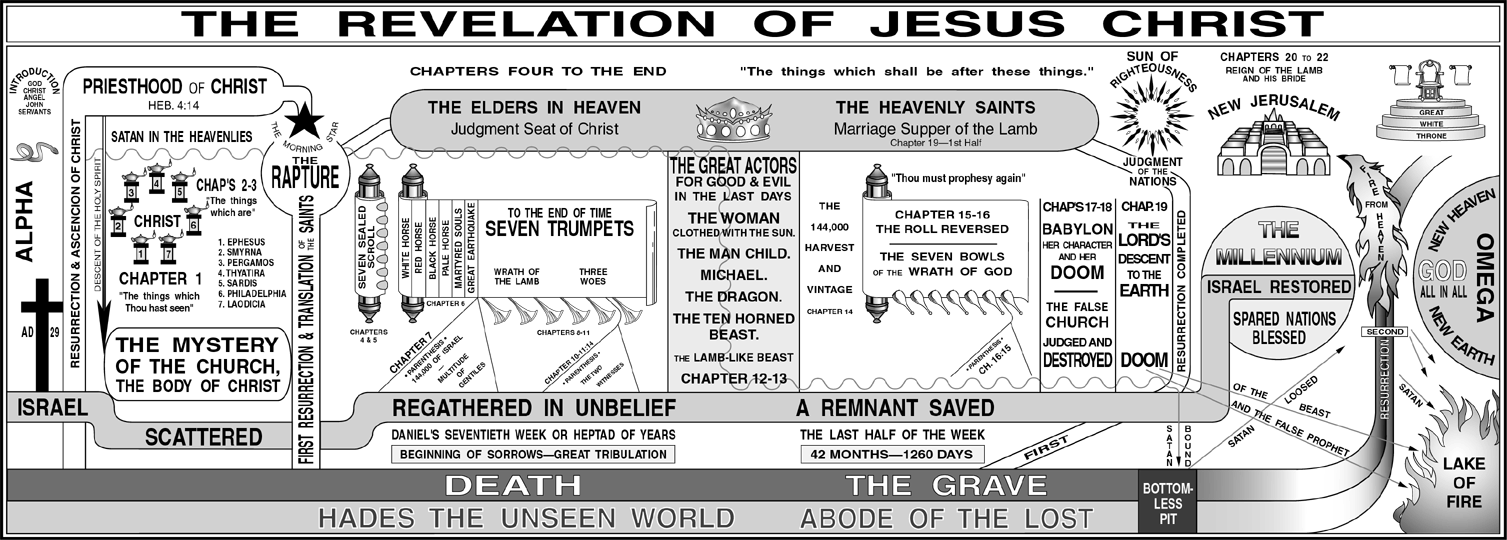
Without Pre-Trib Rapture, Bible Prophecy Has No Context


[Pastor Harry Ironside (1876-1951), a godly Fundamentalist author and teacher for many years, served as pastor of Chicago's Moody Memorial Church from 1930-1948]

The above chart begins with the precious word “Calvary” (by the way, the corrupt modern Bible versions ALL completely remove this word). That's why I only trust and use the King James Bible! Then we see the Gentile Age (the history of the Church). The First resurrection is the pre-Tribulation Rapture when Christ returns FOR His saints (1st Thessalonians 4:17). Then we see that while the raptured saints will go through the Judgment Seat of Christ and the Marriage Supper of the Lamb; while back here on earth the Antichrist will rule the New World Order and God will pour out His wrath upon the world for their wickedness. After the 7-year Tribulation period there will be the Second Coming of Christ (the Lord's descent to the earth).

Christ here returns WITH His saints and the Battle of Armageddon is fought. Armageddon is a literal valley called “Megiddo” in Israel. The Beast (Antichrist) and the False Prophet will be defeated and the Lord will begin His earthly 1000-year reign from Jerusalem over the whole earth. Satan will be bound in chains and imprisoned for 1000-years.

At the end of the 1000-years, there will be a short rebellion after Satan is released from the Bottomless Pit. There will be humans during the Millennium who are the descendants of those saved during the Tribulation period. Some of these people will join Satan in his rebellion against God. Satan and his rebellion will be defeated and then the Great White Throne of Judgment will follow, during which all unsaved people throughout history will be convicted and cast into the eternal Lake of Fire. Satan, the Antichrist, and the False Prophet will also be cast into the lake of Fire to be punished day-and-night forever and ever. This will be the final judgment of all the doomed.

The earth will be burned over, purged with fire and God will make all things new (2nd Peter 3:7,12; Revelation 21:4). The saved throughout history will dwell upon the earth with God forever and ever in genuine love, lasting peace, true happiness, perfect harmony and bountiful plenty. 1st Corinthians 15:28, “And when all things shall be subdued unto him, then shall the Son also himself be subject unto him that put all things under him, that God may be all in all.” Amen and amen!

The Bible Teaches A Pre-Trib Rapture

Without the pre-Trib Rapture doctrine, Bible prophecy has no context.

We are told in Titus 2:13 to LOOK “for that blessed hope, and the glorious appearing of the great God and our Saviour Jesus Christ...” Now, if the Anti-Christ must come first as mid and post tribbers tell us, then this passage makes no sense. Why would we look for Christ if the Man of Sin must precede Him? Those who deny a pre-Trib Rapture remove the element of surprise from Christ's return, which imminent return is plainly taught in the New Testament (Mark 13:32-37; 1st Corinthians 15:51-58; Philippians 3:20; 1st Thessalonians 4:13-18).

I agree with Pastor Harry Ironside's (1876-1951) prophecy chart (shown above) which shows true Israel being restored only when Christ returns at His Second Coming to earth, after the Tribulation period (Jeremiah 23:7-8). This does not affect saving faith.

Pastor Ironside graduated to Heaven in 1951, just 3 years after manmade Israel was created in 1948. His prophecy books had already been long ago published. In Pastor Ironside's thinking Israel would be restored at Jesus' Second Coming, with which position I agree. Hosea 3:4-5 teaches that God will restore Israel when the Jews repent toward God, which they haven't done yet. Present-day Israel is no different than any other heathen nation (Luke 21:24).

Wednesday, February 4, 2026

Are “the Day of the Lord” And “the Day of Christ” The Same Thing?

2nd Thessalonians 2:1-2, “Now we beseech you, brethren, by the coming of our Lord Jesus Christ, and by our gathering together unto him, That ye be not soon shaken in mind, or be troubled, neither by spirit, nor by word, nor by letter as from us, as that the day of Christ is at hand.”

Most Bible commentaries and websites today will erroneously tell you that the 54 King James Bible translators messed up; that “the Day of Christ” is a faulty translation in 2nd Thessalonians 2:2. However, this is simply not the case at all, as the following well-written helpful article delineates...
In 2 Thessalonians 2:1-4 Paul mentions two events that precede the period of the Great Tribulation. The KJV and NKJV state that the “day of Christ” shall not come except “there come a falling away first, and that man of sin be revealed”. Other versions read, “the day of the Lord.” If it is “the day of Christ,” isn’t that the Rapture as in Philippians 1:10 and Philippians 2:16? If the correct reading is “the day of Christ,” how can the “falling away” be the departure of the Church if the “day of Christ” comes first?

The reading in some versions, “the day of the Lord,” originates from the corrupt 1881 Westcott and Hort Greek text which underlies most modern versions and should be rejected.

There are a number of “days” referred to in Scripture. There is “the day of Christ,” “the day of the Lord,” “the day of the Lord Jesus,” “the day of God,” and “the day of God Almighty.” To which period they refer, can only be determined by the context. There is no consistent meaning to any one day.
 
For example:

The expression, “the day of Christ”, occurs only twice elsewhere, in Philippians 1:10 and 2:16, where it undoubtedly applies to the Rapture. The Philippians were to be “without offence till the day of Christ”, and Paul would “rejoice in the day of Christ.” That cannot refer to the Tribulation.

The expression, “the day of the Lord”, occurs five times. (Acts 2:20; 1 Thessalonians 5:2; 2 Peter 3:10; 1 Corinthians 5:5 and 2 Corinthians 1:14). Acts 2:20 quotes Joel 2:31, and its context is the appearing of Christ to judge the nations at the second coming. However, “the day of the Lord” in 1 Thessalonians 5:2 is the Great Tribulation from which the Church is preserved. In 2 Peter 3:10 “the day of the Lord” is the destruction of the earth at the end of the Millennium, when the earth will be burned with fire.

In the Old Testament “the day of the LORD (Jehovah)” occurs 26 times and generally applies to the coming Tribulation (Joel 3:14;Zephaniah 1:14), but it also applies to the destruction of Babylon (Isaiah 13:6,9) which now is fulfilled prophecy. It is the “day of God’s vengeance” (Isaiah 34:8; Jeremiah 46:10) whenever He acts to requite the ungodly. At all times it is a time of terror and fear for men.

The expression “the day of God” occurs twice in Scripture, in 2 Peter 3:12 and Rev.16:14. In 2 Peter 3:12 it is the conflagration at the end of the Millennium. “The day of God Almighty” (Revelation 16:14) refers to the battle of Armageddon at the second coming of Christ.

“The day of the Lord Jesus” in 1 Corinthians 5:5 and 2 Corinthians 1:14 is clearly the Rapture.

The proposition that the term, “the day of Christ”, can only refer to the Rapture, must be checked against the context of Scripture. In the context of 2 Thessalonians 2:2, “the day of Christ” is the Great Tribulation.

It is obvious from all of these references that there is no consistent pattern of meaning attached to each term apart from the context, which emphasizes the absolute necessity to get the context right. A Greek or Hebrew translator MUST understand the passage in order to get the context right, which determines the meanings of words in each application. Vincent, the Greek scholar, did not attempt to comment on the Greek of 2 Thessalonians 2 which, he said in 1886, “I do not understand” (page 67,vol.IV).
 So what is the context of 2 Thessalonians 2? 
  1. The Thessalonian believers feared that “the day of Christ” was “at hand”, or “now present.” Paul saw it as a time of fear that would shake the mind and trouble the believers. The Greek word “shaken” is like “the tossing or swelling of the sea”, and the word “troubled” means to be “unsettled or thrown into confusion”. The Rapture is the opposite, and is our blessed hope. Paul says he would rejoice “in the day of Christ”, but these believers saw the “day of Christ” as a time of terror. 
  2. The believers equated the “day of Christ” to a PERIOD of time, and not an event. The Rapture is a split-second event too fast for the world to see. This is the only place where the Greek word “enistaymee” is translated “at hand.” Five times it is translated “present,” as in Romans 8:38; 1 Corinthians 3:22 and 7:26; Galatians 1:4; Hebrews 9:9. The Thessalonians were concerned that the Tribulation (“day of Christ”) was “NOW PRESENT” (2 Thessalonians 1:4). If “the day of Christ” was the Rapture, their fear would have been that it was a past event.
So if the believers thought that the Tribulation, “the day of the Lord” to which Paul had referred in his first epistle (1 Thessalonians 5:2), had already come, how should we understand “the falling away” (2 Thessalonians 2:3)? The Greek word apostasia is transliterated (not translated) into English as apostasy but that is only one application of the Greek word and it is utterly wrong to translate apostasia as apostasy in every case. The word means “departure.”

The verbal form is applied to a departure from truth in only 3 instances (Luke 8:13; 1Timothy 4:1; Hebrews 3:12). It is a departure from iniquity (opposite to apostasy) in 2Timothy 2:19 from men, in 1 Timothy 6:5, from the Temple Luke 3:37, and from the human body in 2 Corinthians 12:8 An angel departed from Peter – Acts 4:13, the Devil from Christ – Luke 4:13, and the Jews from the Apostles-Acts 5:38.

All English translations before the KJV, translated the Greek word apostasia in 2 Thessalonians 2:3 as departure or departing. They include Wycliffe (1384), Tyndale (1526), Coverdale (1535), Cranmer (1539), Breeches Bible (1576), Beza Bible (1583) and the Geneva Bible (1608).

The definite article “the” is missing from the KJV, whereas it is in the Greek Received Text. Apostasia is a noun, and the article indicates that it was a specific departure known by the reader and previously mentioned by the writer.

In the Epistles to the Thessalonians there is no prior mention of an apostasy or departure of the Church from the truth. Two verses before, however, there is mention of the physical departure of the Church – “our gathering together unto him” (2 Thessalonians 2:1). In the first epistle we have the physical departure of the Church described at length in 1 Thessalonians 4:13-18. It is mentioned in 1 Thessalonians 1:9-10; 2:19; 3:13; 5:9. The thought of the Rapture is still on Paul’s mind in 2 Thessalonians 3:5. If the believers were to be comforted in trial, then their departure would be the greatest comfort, not the prospect of apostasy.

To what departure was Paul referring? If it was the apostasy of the man of sin, then the order is wrong for the “falling away” comes “FIRST.” The man of sin is revealed after the departure. Antichrist’s apostasy, when he sets up his image in the Temple, actually occurs halfway through the 7 years, 42 months later. However, “the departure” is an event, not a period of apostasy.

Why then is “the day of the LORD (Jehovah)” called the “day of Christ?” Because Christ is Jehovah. If “the day of the Lord Jesus” in 1 Corinthians 5:5 and 2 Corinthians 1:14 can be the Rapture, it is not inconsistent for the “day of Christ” be called the day of Jehovah or the Tribulation.

It becomes apparent that there is no exclusive meaning attached to any day of the Lord, Christ, God or the Lord Jesus, apart from the one demanded by each context, and the context in 2 Thessalonians 2:1-12 is all about two events which must occur before the period of God’s wrath falls on the world.

Furthermore, there is a doublet in 2 Thessalonians 2:1-12 which demands that apostasia be the departure of the Church. Two things must occur BEFORE the day of the Lord comes. Verse 3 mentions “the departure” and “that man of sin be revealed”. In verses 7 & 8 the same two events are given. The restrainer is “taken out of the way” and “THEN shall that Wicked be revealed”. The second confirms the first.

Other Scriptures speak of apostasy in the last days (1 Timothy 4:1; 2 Timothy 3:1-7; 2 Peter 3:3-4; and the prophetic significance of the Laodicean Church), however, this passage is clearly showing that the day of Tribulation shall NOT come unless the Church departs FIRST. The Thessalonian believers would thus be reassured and comforted.

There is no greater comfort to the believer in these last days than to know that at any moment we could be caught up with the loved ones who have gone before, to be “for ever with the Lord.” SOURCE
I fully agree. It is clear from studying God's inspired Word that there is no real consistency in the use of these different phrases, which discredits the false claims of many well-meaning religious scholars and clergy that they do have specific meanings. Since Jesus is the Christ, the Lord and Almighty God, these phrases can be (and are) used interchangeable.

Thus, the only way to rightly divide the Word of Truth is to interpret each individual Scripture passage based on its surrounding context. Most heresies are the consequence of lifting a particular text out of context to create a new pretext. So, please don't do that. Always study the surrounding verses in a specific passage to find the proper context.

Everlasting Consolation

2nd Thessalonians 2:1-12, “Now we beseech you, brethren, by the coming of our Lord Jesus Christ, and by our gathering together unto him,  Th...